December 1, 2024 9:51 am
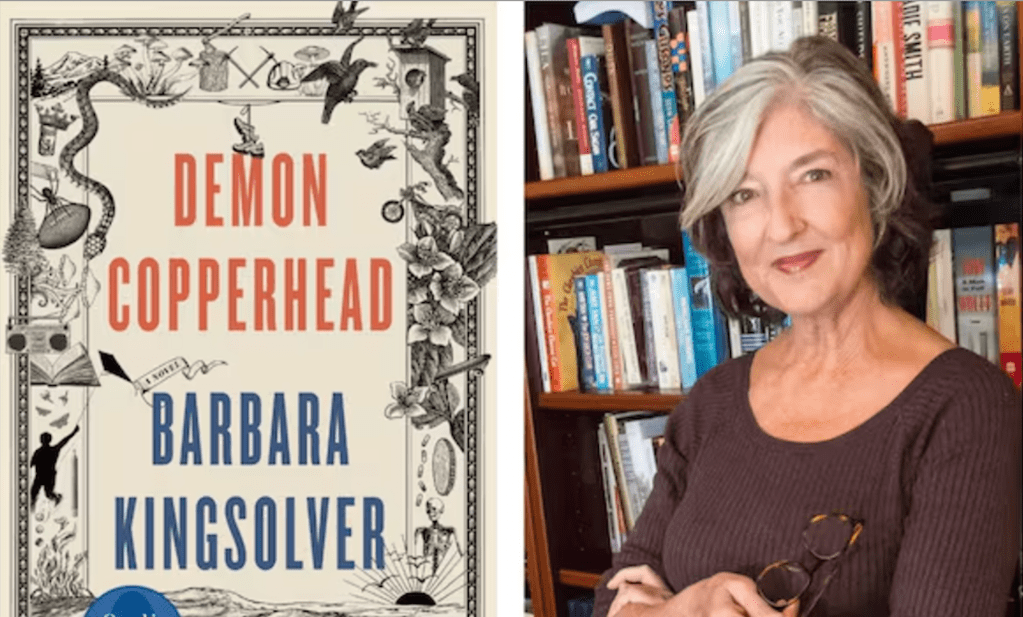
(Courtesy of Harper.)
Elvis Presley sang “Return to Sender.” Today, I’m going to…return to gender. Heck, I’m not even a Presley fan, so excuse my blog-post opening as I write about characters who are the opposite sex of their novelist creators.
While female authors have created many of the most-memorable female protagonists and male authors have created many of the most-memorable male protagonists, skillful novelists can of course successfully cross gender lines. It takes some imagination, some research, and some drawing on experiences with opposite-sex parents, spouses, siblings, children, friends, work colleagues, etc. And authors can obviously include memorable co-stars and supporting characters of the same gender as themselves.
For the purposes of this blog post, I’m going to focus on characters who are in the novels’ titles.
An example of today’s theme that I finally read last week is Barbara Kingsolver’s tour de force Demon Copperhead, the 2022 coming-of-age story of a boy who faces poverty, the death of his parents, foster care, addiction, injury, and other enormous challenges. It’s uncanny how well a female author in her late 60s gets into the psyche of a male who’s a preteen or teen during virtually the entire Pulitzer Prize-winning book — for which Kingsolver took inspiration from Charles Dickens’ 1850 classic David Copperfield while transferring the time and setting from 19th-century England to late-20th-century/early-21st-century Appalachia in the United States.
After finishing Demon Copperhead, I read Gabrielle Zevin’s The Storied Life of A.J. Fikry (2014) — about the prickly (male) owner of an island bookstore. A funny and poignant short novel with some echoes of George Eliot’s compelling classic Silas Marner.
About 150 years earlier, Eliot was an accomplished female author with a male title character in three of her five best-known novels: Adam Bede (1859), Daniel Deronda (1876), and the aforementioned Silas Marner (1861). All three of those men are quite believable and three-dimensional, even as prominent female characters steal (or almost steal) the show.
The 19th century also saw the publication of such female-written works as Mary Shelley’s mega-influential Frankenstein (1818), George Sand’s Jacques (1833), Elizabeth Gaskell’s Mr. Harrison’s Confessions (1851), and Harriet Beecher Stowe’s cry-for-justice Uncle Tom’s Cabin (1852), among other novels.
Moving into the 20th century and beyond, we have Edith Wharton’s emotionally wrenching Ethan Frome (1911), Willa Cather’s okay debut novel Alexander’s Bridge (1912), Colette’s Cheri (1920) and The Last of Cheri (1926), Agatha Christie’s The Murder of Roger Ackroyd (1926), Lord Edgware Dies (1933), and Hercule Poirot’s Christmas (1938), Alice Walker’s The Third Life of Grange Copeland (1970), and (you knew I would get to this eventually 🙂 ) J.K. Rowling’s blockbuster Harry Potter series of seven books published between 1997 and 2007.
And we can’t forget Murasaki Shikibu’s VERY early female-authored-novel-starring-a-man The Tale of Genji, written in the early 11th century.
Given that there were many more male than female authors published pre-1900, we can easily find a slew of male-written novels back then with female title characters: Daniel Defoe’s Moll Flanders (1722), Samuel Richardson’s Pamela (1740), Honore de Balzac’s Eugenie Grandet (1833), Gustave Flaubert’s Madame Bovary (1856), Charles Dickens’ Little Dorrit (1857), Lewis Carroll’s Alice’s Adventures in Wonderland (1865), Emile Zola’s Therese Raquin (1867) and Nana (1880), R.D. Blackmore’s Lorna Doone (1869), Thomas Hardy’s The Hand of Ethelberta (1876) and Tess of the d’Urbervilles (1891), Leo Tolstoy’s Anna Karenina (1878), Henry James’ Daisy Miller (1878), and Mark Twain’s Personal Recollections of Joan of Arc (1896), to name a few.
Plenty of titles after that, too, such as Theodore Dreiser’s Sister Carrie (1900), Herman Wouk’s Marjorie Morningstar (1955), William Styron’s Sophie’s Choice (1979), Walter Mosley’s Rose Gold (2014), and multiple ones by Stephen King — including Carrie (1974), Dolores Claiborne (1992), and Rose Madder (1995).
Your thoughts about, and examples of, this theme?
Misty the cat says: “I’m Nancy Drew starring in ‘The Mystery of the Aromatic Leaves.'”
My comedic 2024 book — the part-factual/part-fictional/not-a-children’s-work Misty the Cat…Unleashed — is described and can be purchased on Amazon in paperback or on Kindle. It’s feline-narrated! (And Misty says Amazon reviews are welcome. :-) )

This 90-second promo video for my book features a talking cat: 🙂
In addition to this weekly blog, I write the 2003-started/award-winning “Montclairvoyant” topical-humor column every Thursday for Montclair Local. The latest piece — about my town’s harassed CFO, unaffordable housing, an environmentally awful plan to cut down many trees, and more — is here.
Posted by Dave Astor
Categories: Uncategorized
Tags: barbara-kingsolver, books, demon-copperhead, fiction, gender, literature
Mobile Site | Full Site
Get a free blog at WordPress.com Theme: WordPress Mobile Edition by Alex King.
Hi Dave,
I wonder if anyone reads Jeffrey Archer anymore? My mum was a fan, so of course when I was a kid, that’s what I was taking off the family bookshelf. I’ve read a couple of his novels and found them to be quite dated. However I’m currently reading “As the Crow Flies” which is quite different. It’s set in the early twentieth century, so you’d expect it to be even more dated than the stuff set in the ‘70s and ‘80s, but I’m finding it really enthralling. And somehow, I’m finding his female characters to be better written and more empowered than the women he sets in his ‘present’ books. It’s a big novel of 600+ pages with points of view that I wasn’t expecting. The first part was all about a young man growing up and going to war and I assumed he’d be the protagonist of the whole novel, but the story has also been narrated by his future wife, as well as some enemies he’s made both at war, and in the business world. So far I think I’ve read three different female narrators and they’ve all been good fun – especially the evil one!
Last night I happened to catch a TV adaptation of John Marsden’s “Tomorrow When the War Began” which made me think of that brilliant YA book series. A group of teenagers spend a couple of days camping in a remote part of Australia, and when they emerge, find that their country is at war. Ellie is voted in as the group’s chronicler and I just love her so much. The character development of the whole group is so well handled as they go from innocent children to war time soldiers. All led by an amazing young woman, written by an old man.
Sue
LikeLiked by 1 person
By Susan on December 12, 2024 at 8:08 pm
Thank you, Sue! Excellent examples, excellently described! I’ve never read Jeffrey Archer, and it’s really interesting to hear that some of his work feels dated but “As the Crow Flies” does not. Some authors definitely have surprises up their sleeves. 🙂
“…an amazing young woman, written by an old man” — very nice turn of phrase!
LikeLike
By Dave Astor on December 12, 2024 at 8:32 pm
Hi Dave,
The older I get, the more sexist some things seem. In some of Stephen King’s older works, there are passages that are… problematic. So I think it’s especially awesome that his first published book, (and the first book of his that I read) was about a sixteen year old girl. I was a teenage girl myself at the time and even though my world wasn’t as traumatic as Carrie’s, and I certainly didn’t have the ability for revenge that she did, I could relate to quite a lot that this young man put down on paper.
I’m currently reading “The Time Traveler’s Wife” which is told from the male point of view of the time traveler, as well as from his female partner’s. I often find both voices read quite similarly, and it’s not a perfect novel, but it’s quite good in places, and I think Niffenegger has done a terrific job at tying a lot of different things together, including the multiple views.
I see Daphne du Maurier’s name mentioned a few times. I recently read “Julius” which was all about a Jewish man’s childhood, adolescence, and eventually adulthood and his own children. He’s not a very nice character, but in du Maurier’s expert hands, still quite a compelling one.
Susan
LikeLiked by 2 people
By Susan on December 4, 2024 at 11:57 pm
Thank you, Sue, for all those great examples and thoughts! Yes, Stephen King and many other authors have their sexist moments on the page, but King has definitely made strong, multiple efforts to get into the psyches of female characters.
As was the case with you and “Carrie,” it can be quite relatable to not only be the same gender but also roughly the same age as a fictional protagonist.
I agree about “The Time Traveler’s Wife.” A novel with significant flaws, but pretty darn good overall.
LikeLike
By Dave Astor on December 5, 2024 at 10:20 am
HI DAve, I don’t think it’s that difficult to write from the perspective of the other gender if you have spent time with the other gender. I have two sons, a husband, a father, and two nephews and I put my knowledge of males at different ages to good use when I wrote Through the Nethergate and A Ghost and His Gold, both of which include main characters from both genders and from different ages. Grandfather in Through the Nethergate is modelled off my father. Father Muike is also modelled on a real person and I used his real name. Stephen King often has multiple characters from both genders in his books. As you mentioned, Agatha Christie had both Hercule Poirot and Miss Marple.
LikeLiked by 1 person
By robertawrites235681907 on December 3, 2024 at 9:34 am
Thank you, Robbie! I totally hear you about how having family members of a different gender enables a writer to better see that other “perspective.” (I’m the opposite of your situation — a male with a wife and two daughters. 🙂 Though Misty the cat is male. 🙂 ) You have put that different-gender knowledge to great use!
Impressive that Agatha Christie created an ultra-memorable female sleuth as well as an ultra-memorable male sleuth.
LikeLike
By Dave Astor on December 3, 2024 at 10:00 am
Agatha Christie was a remarkable writer. I’ve just read The adventure of the Christmas pudding and other stories featuring Hercule Poirot and I can’t get over how clever she was. I thought of a few other books byw. The MC in Nevil Shute’s A Town Like Alice is female and the MC in Ayn Rand’s The Fountainhead is male. Pat Barker features many male characters in her Regeneration series of books.
LikeLiked by 1 person
By robertawrites235681907 on December 3, 2024 at 11:30 am
I’ve only read a half-dozen or so Agatha Christie books, Robbie, but I agree that she was incredibly clever. And thank you for those other examples of authors who skillfully crossed the gender line with their characters. Nevil Shute’s “On the Beach” also had some well-depicted female characters.
LikeLike
By Dave Astor on December 3, 2024 at 2:18 pm
Hi Dave, I still need to read On the Beach. Thank you for the reminder. I started Letters to Father Christmas by Tolkien yesterday.
LikeLiked by 1 person
By robertawrites235681907 on December 4, 2024 at 7:58 am
“On the Beach” is quite a novel, Robbie. More low-key than I expected, but it packs a big emotional punch. And your current Tolkien reading sounds appropriately seasonal. 🙂
LikeLike
By Dave Astor on December 4, 2024 at 9:08 am
Hi Dave, yes, I am enjoying this short collection by Tolkien. It is very light and fun. I will get to On the Beach. I’d actually forgotten about it.
LikeLiked by 1 person
By robertawrites235681907 on December 4, 2024 at 12:51 pm
Tolkien’s writing can be VERY entertaining.
LikeLike
By Dave Astor on December 4, 2024 at 1:17 pm
🌞🌻
LikeLiked by 1 person
By robertawrites235681907 on December 5, 2024 at 12:19 am
🙂
LikeLike
By Dave Astor on December 5, 2024 at 10:15 am
At first I read “Tidal Wave”, (no my eyes aren’t going, my brain is)..
However, after reading your tidal wave of titles, I feel somewhat psychic.
Within this tidal wave are all the books I thought of, not that I’ve read all of the books you mentioned, but I have read many.
I have no choice but to resort to Tennessee Williams. Yes, he wrote plays, but he was a man and 2 of his fabulous plays “The Rose Tattoo” (Serefina Delle Rose) and the fantastic story“Baby Doll” (Baby Doll Meighan )… may qualify, even though they are plays.
OH… Lolita by Vladimir Nabocov!
And… uch another flew in and out of my head faster than a speeding anything.. uch … it was a good one! Okay, if it flies back in, I’ll be back!
LikeLiked by 3 people
By Resa on December 2, 2024 at 5:34 pm
Thank you, Resa! Great mention of Tennessee Williams, who depicted some VERY memorable women in his writing. Also, “A Streetcar Named Desire,” “The Glass Menagerie,” etc. And, yes, “Lolita” from Vladimir Nabokov. I forgot to include that semi-sicko novel!
Enjoyed your tidal-wave riff. 🙂
LikeLiked by 2 people
By Dave Astor on December 2, 2024 at 6:55 pm
Lol.. yes Humbert is a semi-sicko, and brings that quality out quite nicely in the rest. Of course Quilty is no prize, either.
Tennessee Williams is my fave story teller from last century. I say story teller, as he did not write any novels, at least any that I know of and read.
Surf glad my riff amused you! 🤭
LikeLiked by 1 person
By Resa on December 2, 2024 at 10:23 pm
Tennessee Williams was indeed quite a storyteller — who didn’t need to write novels to be quite a storyteller!
LikeLiked by 1 person
By Dave Astor on December 3, 2024 at 9:53 am
One thing is for sure, he always wrote about the SW USA, and starkly revealed that particular society with its tatters and tears via poverty, smallness and prejudices.
Even within the south’s ribbons and bows aspects, he juxtaposed with “mendacity”. (Cat on a Hot Tin Roof).
LikeLiked by 1 person
By Resa on December 3, 2024 at 1:57 pm
Yes! Well said! Tennessee Williams indeed provided lots of regional and cultural insights along with the intense drama.
LikeLiked by 1 person
By Dave Astor on December 3, 2024 at 2:25 pm
Yes! 😻 Pet Misty for me!
LikeLiked by 1 person
By Resa on December 3, 2024 at 4:41 pm
Done! 🙂
LikeLiked by 1 person
By Dave Astor on December 3, 2024 at 5:21 pm
How about Atonement by Ian McEwan with Briony the protagonist and she’s an aspiring writer. Great book and a pretty good film as well.
LikeLiked by 2 people
By Chris Hall on December 2, 2024 at 10:14 am
Thank you, Chris! Briony is indeed a memorable protagonist (though of course not an especially sympathetic one given what she did).
LikeLiked by 1 person
By Dave Astor on December 2, 2024 at 10:25 am
Hi again, Dave. I recalled a few examples last night, but see that you’ve got many of them already. One you haven’t is Balzac’s ‘Cousin Bette’. The BBC dramatised this when I was in my teens, and of course I had to read it. The manner in which the ageing, embittered, poor-relation takes revenge on the well-off relatives who’ve patronised her all her life is shocking, even though she doesn’t have it all her own way in the end. So now I have to re-read it! 😂 Tolstoy’s an interesting one. I used to teach ‘Anna Karenina’, and I hate him punishing her as he does for not conforming to societal expectations of women. His beliefs also feed into Natasha in ‘War and Peace’, and there I think he did badly. She’s lively, intelligent, feeling, wonderful – and then goes crazy because her ‘essential female’ kicks in and she becomes desperate to marry so that she can reproduce. When at length she marries Pierre she turns into a baby-machine, her potential elsewhere discarded in favour of breeding. Obviously there’s nothing wrong with bearing children, it’s an option that women have – and I say that as one who’s never felt the need to exercise it. Doubtless Tolstoy would be horrifed by me! But it does I think illustrate that his capacity for portraying female characters was limited. That doesn’t mean his books weren’t good, but … just saying. 😂
LikeLiked by 3 people
By lyndhurstlaura on December 2, 2024 at 1:57 am
I’ve read a lot of Balzac, but not “Cousin Bette,” so I just put that on my list. Thank you for mentioning it, Laura!
And you’re so right that some long-ago authors who depicted women doing “unconventional” things felt the obligation (pressure?) to “punish” those women by making them die, suffer, become totally conventional, etc. Some exceptions, of course, such as in Anne Bronte’s “The Tenant of Wildfell Hall.”
LikeLiked by 1 person
By Dave Astor on December 2, 2024 at 9:21 am
The Tenant of Wildfell Hall is great, I do think Anne Bronte is underrated. But there are some great depictions of women by male authors, and vice-versa. There was a BBC dramatisation of Cousin Bette many years ago, with the wonderful Margaret Tyzac as Bette – and of course, that was my motivation to read the book. I do think the world is losing out these days by not making loads of dramatisations of the Classics. They do a few, but I grew up with the BBC having a series on the go every Sunday, just after tea. I read my first Classic because of that, and so many others for years. I wish they still did it so that young people could be exposed to them. English teaching is in a dire state over here, with some universities dropping their English Literature degrees. It’s scandalous, our national literature is seen as irrelevant by young people! Sorry, Dave, excuse the rant. My culture is disappearing before my eyes, and it makes me both angry and sad. I shall take myself off to dinner and thence to watch something uplifting on the TV. Have a good day and thanks once more for the thought-provoking post. 🙂 🙂
LikeLiked by 1 person
By lyndhurstlaura on December 2, 2024 at 12:14 pm
I agree, Laura, that the talented Anne Bronte is underrated. I guess that happens when a writer has two sisters who were even more talented as writers.
Dramatizations of classics can indeed be wonderful, and I’d also welcome more of them. As you allude to, perhaps they’re not appealing enough for some young people — and for producers. There’s unfortunately a good deal of anti-intellectualism happening in quite a few countries, which of course affects universities and other societal institutions. 😦
LikeLiked by 1 person
By Dave Astor on December 2, 2024 at 12:32 pm
So right. And when they do dramatise Classics, they do a bad job. I did a blog way back when I first launched my website and blog, about a rubbish alleged dramatisation of ‘Great Expectations’. I called it ‘Low Expectations’. Think Miss Havisham smoking opium with Estella and setting Pip up with a hooker, Pip’s aunt working as a dominatrix … you get my drift. Dickens must have been turning in his grave!
LikeLiked by 1 person
By lyndhurstlaura on December 2, 2024 at 1:37 pm
Yikes! Sounds like a problematic adaptation indeed! 😦 Modernizing a classic sometimes works, but…
LikeLiked by 1 person
By Dave Astor on December 2, 2024 at 3:47 pm
Indeed. This one was dire. I only watched because they filmed some scenes outside the apartment of an old acquaintance. It has since quietly died a death … 🙂
LikeLiked by 1 person
By lyndhurstlaura on December 2, 2024 at 5:27 pm
Nice to see a familiar sight/site, at least.
LikeLiked by 1 person
By Dave Astor on December 2, 2024 at 6:46 pm
Interesting thoughts! I think Dave’s article is very thought-provoking indeed; I enjoy your blog a lot, Dave! As an aside, I commented on your site, Laura, and I think I was sent to the spam folder, if you want to liberate me! Thanks for sharing such a great post, Dave. 😊
LikeLiked by 2 people
By The Introverted Bookworm on December 8, 2024 at 10:44 am
Hi there, sorry to hear that. I’ll have a look around and see if I can find your comment. Thanks for the comment, whatever it was. I’ll get back to you on it. 🙂 🙂
LikeLiked by 2 people
By lyndhurstlaura on December 8, 2024 at 12:25 pm
Thank you, Ada! Glad you enjoy the blog. 🙂
LikeLiked by 1 person
By Dave Astor on December 8, 2024 at 1:16 pm
Hi again, sorry it took me a while to get back, yesterday was too busy with non-blog-related work. But I got back here and I’m afraid I can’t find your comment anywhere. Why does this happen? I’ve had my own comments to others’ sites disappear, and it’s very annoying. If you want to give me the gist of the lost comment here though I’d be very glad to read it at last. 😊
LikeLiked by 1 person
By lyndhurstlaura on December 9, 2024 at 11:46 pm
I think it’s something to do with the spam folder/filters! It’s really annoying! I’ll keep making comments and maybe one will reach you! I was just commenting on your insightful Christmas Carol post 💜
LikeLiked by 2 people
By The Introverted Bookworm on December 10, 2024 at 6:58 am
I’m so cross about this, as I enjoy receiving and responding to comments. I’ll keep an eye out in future, and hope that your next one gets through. Thanks for the comment though, whatever it was. Have a good week. 🙂
LikeLiked by 2 people
By lyndhurstlaura on December 10, 2024 at 8:03 am
Excellent topic! I’m a 61-year-old white guy. About five years ago, I decided to write a first-person novel from the viewpoint of a 36-year-old Black man. The initial idea terrified me so much that I wasn’t going to do it, but that wound up being part of the appeal, and eventually a great source of pride. I found it harder to be young than to be Black. Then I had fun turning my family members into Black people, and I even turned my little brother into my little sister. But in 28 books, I’ve never crossed the gender line. I probably can’t. I’m impressed by your examples and plan to read the ones I haven’t. Free Kindle samples, anyway. Oh, and Anne Tyler’s a master of writing male characters.
LikeLiked by 3 people
By Michael LaRocca on December 1, 2024 at 5:18 pm
Thank you, Michael! An impressive feat you pulled off for that first-person novel of yours. Imagination, the knowledge that human emotions transcend things like age and race, etc., can go a long way. 🙂 Congratulations on that, and on writing 27 other books!
You’re right about Anne Tyler — in novels such as “The Accidental Tourist.” She’s great at depicting female characters, too. 🙂
LikeLiked by 2 people
By Dave Astor on December 1, 2024 at 6:07 pm
I’m comfortable enough in Grady Mela’s to have turned that novel into a trilogy.
LikeLiked by 1 person
By Michael LaRocca on December 2, 2024 at 6:41 pm
Fantastic, Michael! Congratulations!
LikeLike
By Dave Astor on December 2, 2024 at 6:57 pm
I have to include novels by Jeanette Winterson, who is always pushing the boundaries of gender. Her books, like The Passion, Written On The Body, etc are great reads and thought-provoking as well. Below is a link re an interview with her for those who are unfamiliar with her body of work. Btw, I don’t care for Elvis at all after finding out about his meeting with Nixon, and his wanting to end the Beatles careers. Why rich and powerful people can’t stay in their own lane is beyond me. Nice theme Dave. Susi
https://www.theparisreview.org/interviews/1188/the-art-of-fiction-no-150-jeanette-winterson
LikeLiked by 3 people
By Anonymous on December 1, 2024 at 4:36 pm
Thank you, Susi! I appreciate the mention of Jeanette Winterson! And, yes, Elvis was sort of a mixed bag as a person, which of course often happens when someone reaches that rarified level of fame. His meeting with Nixon was indeed bizarre and disturbing, and The Beatles certainly had a creative advantage over Elvis in that they wrote most of their songs while Elvis performed songs written by others.
LikeLiked by 1 person
By Dave Astor on December 1, 2024 at 6:01 pm
Interestingly Dave, I find I am just as comfortable with writing male main characters as female! I read your excellent post with such interest! Thanks Dave!
LikeLiked by 3 people
By Sharon's Writers Tidbits on December 1, 2024 at 4:24 pm
Thank you, Sharon! Glad to hear about your comfort level with writing both female and male characters. A sign of an excellent writer. 🙂
LikeLiked by 2 people
By Dave Astor on December 1, 2024 at 5:56 pm
Ahh! Thank you Dave! That’s so nice of you to say! Lovely post once again!
LikeLiked by 2 people
By Sharon's Writers Tidbits on December 1, 2024 at 6:09 pm
You’re welcome, Sharon, and thank you for your kind words about the post!
LikeLiked by 1 person
By Dave Astor on December 1, 2024 at 6:11 pm
Oh yes, me too. I might not be a brilliant writer (meaning me) but male and female are both fine, I’d say.
LikeLiked by 2 people
By Chris Hall on December 2, 2024 at 9:08 am
Sounds good to me, Chris. And you ARE a terrific writer. (Your poetry, your ongoing Raconteuse saga, etc. 🙂 )
LikeLiked by 1 person
By Dave Astor on December 2, 2024 at 9:22 am
Aww, you’re so kind. Thanks, Dave😊
LikeLiked by 1 person
By Chris Hall on December 3, 2024 at 2:17 am
You’re very welcome, Chris! 🙂
LikeLiked by 1 person
By Dave Astor on December 3, 2024 at 9:54 am
I’m glad I’m not alone!!! Thank you so much for commenting! All the best with your writing. Sharon
LikeLiked by 2 people
By Sharon's Writers Tidbits on December 2, 2024 at 2:11 pm
Isabel Archer in Henry James’ “The Portrait of a Lady” was arguably the most complex and convincing female protagonist written by a male author.
LikeLiked by 2 people
By Tony on December 1, 2024 at 3:19 pm
Thank you, Tony! Isabel Archer was indeed a GREAT, expertly depicted character. “The Portrait of a Lady” is my favorite Henry James novel of the dozen or so I’ve read.
LikeLiked by 1 person
By Dave Astor on December 1, 2024 at 5:45 pm
An interesting theme, Dave. I’ve observed that female authors bring a sensitivity to male characters that make them endearing. Kingsolver’s Demon Copperhead is a masterpiece.
LikeLiked by 2 people
By Rosaliene Bacchus on December 1, 2024 at 2:41 pm
Thank you, Rosaliene! I agree that many female authors bring a sensitivity to male characters (and female ones). I also agree that “Demon Copperhead” is a masterpiece amid Barbara Kingsolver’s impressive canon — which includes several other masterpieces or near-masterpieces.
LikeLiked by 2 people
By Dave Astor on December 1, 2024 at 3:10 pm
I thank you for introducing me to Kingsolver’s impressive canon 🙂
LikeLiked by 1 person
By Rosaliene Bacchus on December 2, 2024 at 1:10 pm
You’re very welcome, Rosaliene! I love how all of us here and in other blogs introduce each other to various writers. 🙂
LikeLiked by 1 person
By Dave Astor on December 2, 2024 at 1:15 pm
🙂
LikeLiked by 1 person
By Rosaliene Bacchus on December 2, 2024 at 2:10 pm
🙂
LikeLiked by 1 person
By Dave Astor on December 2, 2024 at 3:48 pm
Another challenging and exciting topic, Dave. First of all, “return to sender” very much applies on this side of the border. Canada Postal strike is going into a second week. Your post reminded me that understanding all sides of a situation is critical. Writers who write successfully in the voice of another, whether it be a different gender, culture, belief system, animals or children, have a capacity to delve into the story, envisioning themselves as the character. Our community has many writers who have this capacity. I remember Shey telling me that she would know when the words didn’t fit the character. Darlene creates Amanda adventures in the voice of an 8 year old. You write in the voice of Misty.
I agree that when writers immerse themselves in the culture, language, and social dynamics of another entity (think of the science fiction writers who write about aliens), they create more nuanced and relatable characters, ultimately enriching their narratives and fostering a greater understanding among readers.
The author that came to my mind, while reading your post is Alexander McCall Smith and his series of novels featuring the No. 1 Ladies’ Detective Agency, set in Botswana. The agency is run by the resourceful and insightful Precious Ramotswe, who navigates various cases with a blend of intuition and traditional wisdom. He has an amazing way of writing in Precious’s name and featuring the vibrancy of Botswana’s culture and landscape.
I have become very attached to Precious Ramotswe. Her wisdom and compassion resonate with me. One of my favourite quotes:
“Perhaps her shoes would say something; Mma Makutsi had told her once, jokingly— and she must have been joking— told her that her shoes occasionally gave her advice. Well, perhaps they could tell her not to be so bossy. They must have witnessed it after all— shoes see everything; there are no secrets we can keep from our shoes.” Alexander McCall Smith, The No. 1 Ladies’ Detective Agency (No. 1)
LikeLiked by 4 people
By Rebecca Budd on December 1, 2024 at 2:06 pm
Thank you, Rebecca! Great descriptive thoughts about this topic — and great example of a male author creating a great female protagonist! I’ve wanted to read Alexander McCall Smith’s series for a while, but my local library never has the first book (though it always has some of the subsequent books). 😦 One of these days…
Sorry about your postal strike. I hope the employees get a fair deal in order for the work action to end in a satisfactory way.
Last but not least, I enjoyed that shoe quotation. 🙂
LikeLiked by 2 people
By Dave Astor on December 1, 2024 at 3:08 pm
I am with you on the employees, Dave. Their concerns are very real. For example, mail couriers that deliver mail in minus 40C should have “warm-up” times.
LikeLiked by 2 people
By Rebecca Budd on December 1, 2024 at 3:34 pm
Yikes, Rebecca. Those are some serious weather challenges for the workers, in addition to other challenges they face in that profession. Wishing them luck!
LikeLiked by 1 person
By Dave Astor on December 1, 2024 at 5:50 pm
I once listened to Michael Ondaatje read from his fourth novel, Anil’s Ghost. During the Q & A following, someone asked how he could write from a women’s point of view. He shrugged and said, “I have a wife, a daughter, a mother and sisters as well as many female friends. I had no trouble writing from a female’s point of view.” Carol Shield’s said something similar when she wrote Larry’s Party. She said it was fun to write from a male’s perspective. Your list includes excellent examples.
LikeLiked by 4 people
By Darlene on December 1, 2024 at 12:56 pm
Thank you, Darlene! So true that most novelists had or have various people of different genders in their lives. Michael Ondaatje made an excellent point! (His “The English Patient” certainly has very strong female characters.)
LikeLiked by 3 people
By Dave Astor on December 1, 2024 at 1:05 pm
Thank you Dave, for this very interesting topic and for all your exemples of opposites gender novels. I have just started reading Demon Copperhead and it really makes me curious! The writer I wanted, however, to mention is William Shakespeare, and maybe King Lear, where the three of his daughters are really convincing. Their is Cordelia, who really loves her father and the two sisters, who are above all interested in their property. Maybe I can also mention Otello and Romeo and Julia where Shakespeare makes them struggle against the wishes of their father. All the best.
LikeLiked by 4 people
By Martina Ramsauer on December 1, 2024 at 12:52 pm
Thank you, Martina! You’re so right that Shakespeare was superb at depicting both women and men, and I appreciate your examples of some of his female characters. And exciting to be starting “Demon Copperhead”! A mostly depressing book, but VERY worth reading. I think Barbara Kingsolver is one of the best current novelists.
LikeLiked by 1 person
By Dave Astor on December 1, 2024 at 12:59 pm
:):) I didn’t know what you told me concerning Barbara Kingsolver!
LikeLiked by 2 people
By Martina Ramsauer on December 1, 2024 at 1:05 pm
🙂
LikeLike
By Dave Astor on December 1, 2024 at 1:06 pm
I read “The House of the Strand” which is very different. My favourite DuMaurier is Jamaica Inn.
LikeLiked by 3 people
By Rebecca Budd on December 1, 2024 at 2:24 pm
I’ll look for “Jamaica Inn,” Rebecca! And “The House on the Strand” is indeed quite different from other du Maurier works.
LikeLiked by 1 person
By Dave Astor on December 1, 2024 at 3:12 pm
Dave – I found that DuMaurier portrayed the male characters in Jamaica Inn with a strong sense of realism. I had to close the book a couple of times because of the realism of the “wreckers.”
LikeLiked by 1 person
By Rebecca Budd on December 1, 2024 at 3:31 pm
Thank you Rebecca for your proposal. I don’t know this book but I like her Rebecca!
LikeLiked by 2 people
By Martina Ramsauer on December 1, 2024 at 3:56 pm
You definitely have me interested, Rebecca. Hoping my local library will have “Jamaica Inn” during my next visit. 🙂
LikeLiked by 1 person
By Dave Astor on December 1, 2024 at 5:47 pm
Shakespeare is an excellent mention, Martina.
LikeLiked by 2 people
By Rebecca Budd on December 1, 2024 at 2:25 pm
Hi Martina. I love that you brought Shakespeare into this. I was about 12 when my school 6th form performed ‘The Winter’s Tale’ – an all-female production, which would have given Shakespeare’s society something to think about. The character who stood out for me was Paulina, who dares to tell Leontes what’s what, and assists the eventual outcome in hiding the queen until Perdita is found. She’s strong, not caricatured, and so brave. She’s remained my favourite Shakespeare character ever since. A tour de force of a man creating a strong female character.
LikeLiked by 2 people
By lyndhurstlaura on December 2, 2024 at 1:38 am
I didn’t know “The Winter’s Tale”, Laura, and thank you very much for having presented it here.:)
Well, Paulina really seems to be a very strong character, who dares to stand up against the king Leontes and his wrongdoings, but it seems also that she never succeeds in forgiving him.
I enjoyed this conversation!
LikeLiked by 2 people
By Martina Ramsauer on December 2, 2024 at 3:38 am
Me too. What really got me about Paulina was when Leontes tells her he’ll have her burnt, and she responds with ‘I care not!’ Respect or what? Great talking to you. 😎
LikeLiked by 2 people
By lyndhurstlaura on December 2, 2024 at 7:09 am
:):) Well, Paulina may have done what she had to and the rest didn’t interest her anymore? All the best, Laura.
LikeLiked by 2 people
By Martina Ramsauer on December 2, 2024 at 8:43 am
Oh no, she had loads more to do, and she did it too. Great character! 🙂 Have a good week, Martina.
LikeLiked by 2 people
By lyndhurstlaura on December 2, 2024 at 9:03 am
Interesting topic and a great list, Dave. I’m not sure I can add anything to this. I had thought of the Twain novel you mentioned.
LikeLiked by 2 people
By Dan Antion on December 1, 2024 at 11:51 am
Thank you, Dan! Interesting that “Personal Recollections of Joan of Arc” was told from the point of view of a male. For the most part, Twain just couldn’t quite get into the psyches of female characters in his various novels.
LikeLiked by 2 people
By Dave Astor on December 1, 2024 at 12:37 pm
I really like how you mull over topics of literature. And you noted fantastic examples of this topic. A couple stood out to me… you’re spot-on about “Ethan Frome” being emotionally wrenching — that was one of the saddest books I’ve read. My wife and I loved the strength of the character in “Tess of the d’Urbervilles” that we named one of our daughters Tess. I can’t think of any other books that you didn’t list here. Great job with these examples!
LikeLiked by 3 people
By Dave Williams on December 1, 2024 at 11:48 am
Thank you, Dave! Wow — what a tribute to that Thomas Hardy novel to name one of your daughters Tess!
I agree that “Ethan Frome” is a VERY sad book. But I’m glad I read it. One could really relate to two “sides” of that triangle of rural Massachusetts characters. And it was interesting to see Edith Wharton not focus on New York City characters who are rich, trying to get rich, or trying not to become un-rich — as she did in the excellent “The House of Mirth,” “The Age of Innocence,” “The Custom of the Country,” etc.
LikeLiked by 2 people
By Dave Astor on December 1, 2024 at 12:35 pm
I was going to say Madame Bovary, but you beat me to it! How about the gender-bending Orlando by Virginia Woolf?
Actually, Misty, “The Mystery of the Aromatic Leaves” sounds appealing to me.
LikeLiked by 3 people
By Liz Gauffreau on December 1, 2024 at 11:24 am
Thank you, Liz!
“Orlando” is definitely in a compelling gender-bending genre that also includes novels such as Jeffrey Eugenides’ “Middlesex” and Abigail Tarttelin’s “Golden Boy.”
Ha! 😂 Misty would be even happier if “The Mystery of the Aromatic Leaves” included a (literal) red herring. 🙂
LikeLiked by 3 people
By Dave Astor on December 1, 2024 at 12:14 pm
Sorry, Misty. I don’t do herring, not even for you.
LikeLiked by 2 people
By Liz Gauffreau on December 1, 2024 at 4:22 pm
LOL, Liz! 😂
Misty will seek seafood elsewhere… 🙂
LikeLiked by 1 person
By Dave Astor on December 1, 2024 at 5:54 pm
Good decision!
LikeLiked by 1 person
By Liz Gauffreau on December 1, 2024 at 7:09 pm
🙂
LikeLiked by 1 person
By Dave Astor on December 1, 2024 at 7:21 pm
Thanks for this very interesting post and for the long list of authors whose protagonists belonged to the opposite sex. 🙏
LikeLiked by 2 people
By luisa zambrotta on December 1, 2024 at 11:21 am
Thank you, Luisa! I’m pleased that you found the post to be interesting! 🙂
LikeLiked by 2 people
By Dave Astor on December 1, 2024 at 11:23 am
As always, you’re more than welcome, Dave 🙏🤗🙏
LikeLiked by 2 people
By luisa zambrotta on December 1, 2024 at 11:46 am
🙂
LikeLiked by 2 people
By Dave Astor on December 1, 2024 at 12:28 pm
As noted below, Dave, that is a big subject. I’ve read many of the books listed above – ‘Ethan Frome’ just last week – and never thought too much about the gender of the author being the opposite of their main character. I’ll have to have a think and see if I can come up with any that you haven’t mentioned – which will be difficult, I think, as that’s a pretty comprehensive list. I’ll be cheeky though for now, and throw my own ‘Degenerate, Regenerate’ into the arena. It’s not well-known (obviously) but both MCs are male. I don’t know if I made a good job of it or not, but I’ve had no complaints. Thanks for another good topic – I’ll be back! 🙂
LikeLiked by 3 people
By lyndhurstlaura on December 1, 2024 at 11:01 am
Thank you, Laura! Yes, when an author is good enough, she or he being a different gender than their protagonist is not a huge thing — though I do think about it a little as I read the novel.
“Ethan Frome” is riveting.
Your getting no complaints about male characters you created is a high compliment!
LikeLiked by 2 people
By Dave Astor on December 1, 2024 at 11:09 am
Your post has made me think about it, and I never really did before, so I hope I’ve got it right with my male characters. And I only read ‘Ethan Frome’ because someone here on WordPress mentioned it recently. I don’t know why I haven’t read it before, I enjoy Edith Wharton’s stories. 🙂
LikeLiked by 3 people
By lyndhurstlaura on December 1, 2024 at 11:56 am
Edith Wharton was indeed a terrific short-story writer — including her ghost tales.
LikeLiked by 2 people
By Dave Astor on December 1, 2024 at 12:28 pm
I love her longer novels. Looks like I have a lot more to look forward to! 🙂
LikeLiked by 1 person
By lyndhurstlaura on December 1, 2024 at 2:32 pm
She was quite prolific. 🙂
LikeLiked by 1 person
By Dave Astor on December 1, 2024 at 3:13 pm
Just a bit … 😂
LikeLiked by 1 person
By lyndhurstlaura on December 1, 2024 at 3:15 pm
😂
LikeLiked by 1 person
By Dave Astor on December 1, 2024 at 3:15 pm
An interesting and thoughtful post, Dave. Ah, “Madame Bovary” — a classic, for sure. I loved the way her internal struggle was so well mapped, and I never thought of it in terms of Flaubert getting into a female mindset. I see what you mean, and I actually think that it works quite well, as the opposite gender can actually provide insights that are relatable in a new way, if you catch my drift! Also, “I’ll never be Young Again” is one of my favorite books, and a testament to Daphne du Maurier’s ability to adopt a male POV. 📚🙂
LikeLiked by 5 people
By The Introverted Bookworm on December 1, 2024 at 10:43 am
Hi there. It was a tour de force by Flaubert, and his statement when charged with indecency for publishing it ‘I am Madame Bovary’ makes me wonder just how different male/female mindsets are n fact. Flaubert expressed much of his own dissatisfaction with the society within which he lived through Emma – perhaps those issues came better from a woman? I tend to wonder if we’ve all got the same capacity, but are socialised from birth to suppress/express those characteristics expected from us as either male or female? Sorry, I’m not putting this very well, but your comments got me thinking about Flaubert and Emma. Thanks for the thought-workout! 🙂
LikeLiked by 3 people
By lyndhurstlaura on December 1, 2024 at 10:55 am
Thank you, Ada and Laura! Flaubert did seem to get into the female mindset quite well in “Madame Bovary.” (Though when I think of French novelists, it’s hard to do better than Colette did in that respect.)
And an excellent point that there can be an additional perspective an author can provide when creating a different-gender character than a same-gender character.
Daphne du Maurier also did quite well with the male POV in “My Cousin Rachel” and “The House on the Strand.”
LikeLiked by 4 people
By Dave Astor on December 1, 2024 at 11:19 am
It’s a long time since I read any Daphne du Maurier – I’ll have to rectify that. 🙂
LikeLiked by 3 people
By lyndhurstlaura on December 1, 2024 at 11:53 am
She’s definitely always worth reading!
LikeLiked by 2 people
By Dave Astor on December 1, 2024 at 11:58 am
Yeah, I love “Rebecca” but some of the lesser-well-known books are amazing as well. And yes, I agree; I think we are socialized from birth onward in terms of “gender,” which is why I enjoy writing from an alternative male/female POV in my stories, plus it’s just plain fun to do so, lol! I think Daphne du Maurier enjoyed this as well, along with all the other amazing authors Dave highlighted. 💜📚😃
LikeLiked by 3 people
By The Introverted Bookworm on December 1, 2024 at 11:59 am
Thanks, and I agree. It’s great to write from both male and female perspectives. Hopefully the more we do the better we’ll get at it. Daphne du Maurier is now on my TBR pile – and it was groaning already! 🙂
LikeLiked by 3 people
By lyndhurstlaura on December 1, 2024 at 12:01 pm
Loved “My Cousin Rachel” as well. I’ve not read “The House on the Strand” but will have to pick it up sometime! Plus, you mentioned “Harry Potter,” which, amazingly, I’ve never read!😃
LikeLiked by 2 people
By The Introverted Bookworm on December 1, 2024 at 12:01 pm
I’m enjoying your continuing conversation, Laura and Ada!
“The House on the Strand” is a very intriguing time-travel book. A late-career effort by du Maurier — published in 1969.
You’re in for a real treat, Ada, if and when you read the “Harry Potter” series! I felt it deserved all the hype and sales.
Laura, I very much agree that authors should do both female and male perspectives as much as possible. Even some great male novelists didn’t depict females often enough and/or three-dimensionally enough — Twain, Melville, Dickens, Tolkien, Cormac McCarthy, etc.
LikeLiked by 2 people
By Dave Astor on December 1, 2024 at 12:26 pm
I loved Frenchman’s Creek!!
LikeLiked by 2 people
By Rebecca Budd on December 1, 2024 at 2:17 pm
Now that’s a BIG topic to cover.
And, ulp, I remember Return to Sender… ‘address unknown/ no such number/no such zone….’
LikeLiked by 3 people
By michael9murray on December 1, 2024 at 10:30 am
Thank you, Michael! I remember that song, too, albeit recently. My younger daughter (now 17) somehow got into an Elvis phase seven or eight years ago and played a greatest-hits CD a LOT. She’s thankfully now over it — more into Taylor Swift, etc. 🙂
LikeLiked by 3 people
By Dave Astor on December 1, 2024 at 11:05 am
Thank you to Becky Ross Michael for recommending the author Gabrielle Zevin!
LikeLiked by 1 person
By Dave Astor on December 1, 2024 at 9:53 am